From PMR to HAMR & MAMR: The Evolution of HDD Stacking and SMR Technology
From PMR to HAMR & MAMR: The Evolution Logic and Engineering Practice of HDD Stacking Technology
Introduction: Why Mechanical Hard Drives Still Dominate Mass Storage
In the consumer market, Solid State Drives (SSDs) have become the standard for PCs and high-performance servers due to their overwhelming advantage in random read/write performance. However, in enterprise data centers, cloud storage, and large-scale archiving scenarios, the position of the Mechanical Hard Disk Drive (HDD) remains solid. The fundamental reason lies in the unit capacity cost—current mainstream 30TB-class enterprise HDDs cost approximately $20 per TB, whereas the cost of enterprise-grade SSDs of the same capacity ranges from $90 to $112, a price difference of 4.5 to 6 times. For deployment scales above the Petabyte (PB) level, this cost difference directly impacts Capital Expenditure (CAPEX) and Operating Expense (OPEX) models.
Furthermore, workloads such as AI large-model training, ultra-high-definition video distribution, and IoT data archiving possess “write once, read infrequently” access characteristics. They do not require high random IOPS but are extremely sensitive to sequential bandwidth and capacity density. This is precisely the advantage of HDDs—they do not need to stack expensive NAND flash layers for every GB of capacity like SSDs; instead, they achieve capacity climbs with a smoother cost curve through iterations in mechanical structure and HDD Stacking Technology such as PMR, SMR, HAMR, and MAMR.
However, capacity improvement is not without a ceiling. The 3.5-inch standard size has remained unchanged since it was established in the 1980s. Hard drive manufacturers must seek breakthroughs in storage density within a fixed volume. This path can be decomposed into two parallel directions: Physical Stacking (increasing the number of platters within a single drive) and Logical Stacking (increasing the recording density per square inch of the disk surface). This article will systematically sort through these two technical threads.
Chapter 1: Basic Structure of HDDs and Physical Bottlenecks of Multi-Disk Stacking
1.1 Internal Structure Overview
The core components of a standard 3.5-inch HDD include:
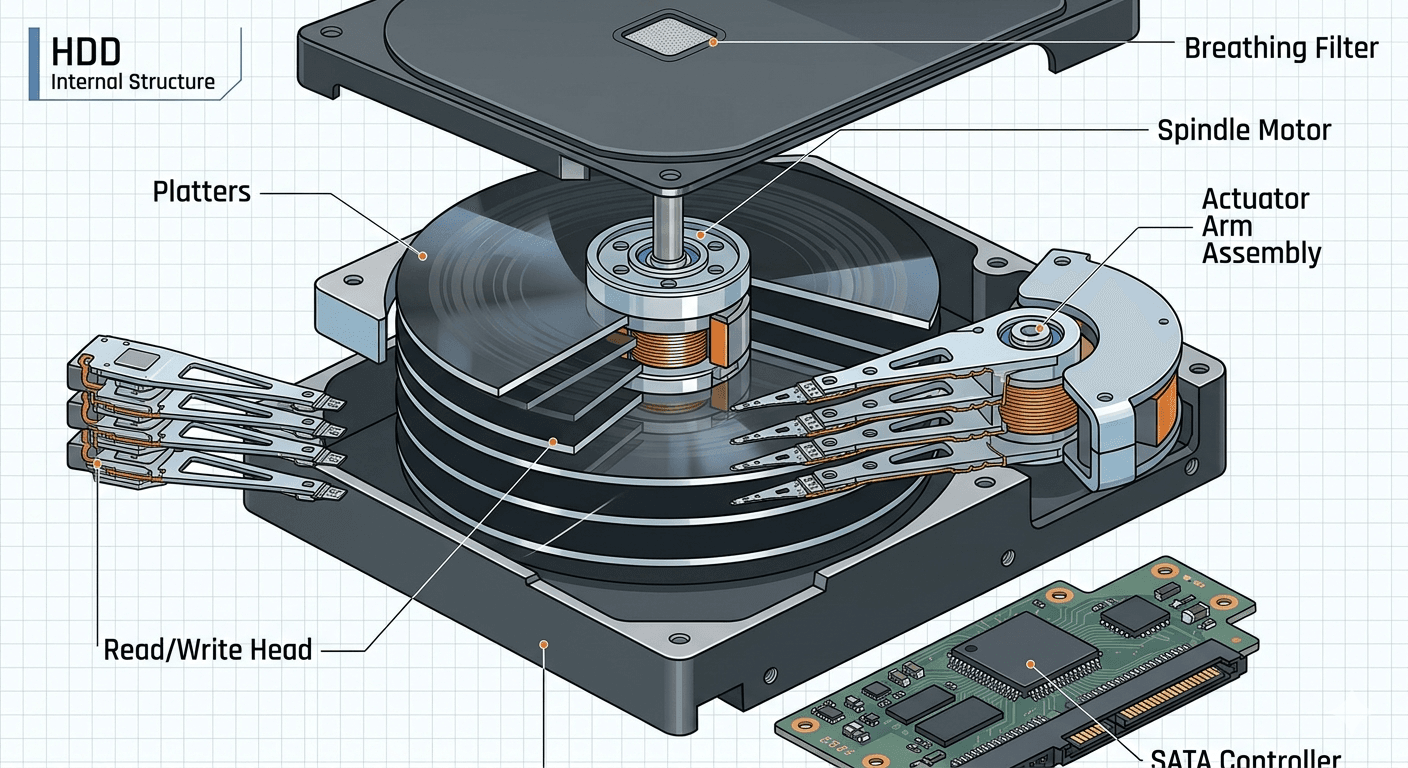
- Platters: Circular substrates made of aluminum alloy or glass, with multiple layers of magnetic thin film deposited on the surface, serving as the physical carrier of data. Each platter has two recording surfaces (front and back).
- Spindle Motor: Drives all platters to rotate at a constant angular velocity. Common speeds are 5400rpm, 7200rpm, with some high-performance models reaching 10000rpm or higher.
- Actuator Arm Assembly: A group of cantilever structures with read/write heads mounted at the ends. All arms move in unison through a single pivot, driven by a Voice Coil Motor (VCM) for seeking motion along the platter radius.
- Read/Write Head: Each recording surface corresponds to one head, suspended above the platter surface with a flying height typically lower than 5 nanometers—much smaller than the diameter of a dust particle.
Data is distributed across the platter surface in the form of concentric tracks, with each track divided into several sectors. Read/write operations go through two stages: Seeking (moving the head to the target track) and Rotational Latency (waiting for the target sector to rotate under the head). Since all platters rotate on the same axis, the number of disks directly determines the total recording area of the hard drive.
1.2 Stacking Limits in the Air-Filled Era
In traditional air-filled hard drives, increasing the number of platters faces two major engineering obstacles:
Airflow Resistance and Power Consumption. When platters rotate at high speeds in the air, they drive the surrounding gas to form a turbulent boundary layer. When disk spacing narrows and the quantity increases, airflow shear forces rise sharply. The spindle motor must output more torque to maintain the rated speed, leading to significant increases in power consumption and heat generation.
Platter Vibration and Head Positioning Error. Non-stationary pressure exerted by high-speed airflow on the platter surface induces bending vibrations, known as “Disk Flutter.” In multi-disk structures, the airflow coupling effect of adjacent platters amplifies the vibration amplitude. Heads need to track tracks only dozens of nanometers wide at a nanometer-precision flying height; any micrometer-level tremor will cause Position Error Signal (PES) to exceed limits, triggering read/write retries or irrecoverable errors.
Restricted by these factors, the platter count for air drives remained stuck at 5 to 7 for a long time, and single-drive capacity hit a ceiling near 4TB around 2010.
Chapter 2: Helium Sealing Technology — Breaking the Physical Barrier of Multi-Disk Stacking
2.1 Physical Properties and Engineering Advantages of Helium
In 2013, HGST (now part of Western Digital) released the first commercial Helium-sealed HDD, the Ultrastar He6, with a 6TB capacity and 7 platters. This technology fundamentally changed the internal gas environment of the drive—replacing air with Helium of a purity higher than 99.9% and permanently sealing the drive body.
The choice of Helium is based on its fundamental physical attributes:
- Low Density: Helium density is about 1/7th that of air, significantly reducing the aerodynamic drag of platter rotation.
- High Thermal Conductivity: Helium’s thermal conductivity is about 6 times that of air, facilitating the conduction of heat from the spindle and VCM to the outer casing.
- Chemical Inertness: Helium does not chemically react with platters, heads, or lubricants, avoiding oxidative degradation.
2.2 Improvements in Stacking Capability and Reliability
The direct benefits brought by the Helium environment are reflected in the following areas:
Compression of Disk Spacing. The reduction in airflow resistance allows engineers to reduce platter spacing from approximately 1.5mm in air drives to about 1.0mm. Within the standard 26.1mm internal height, the platter upper limit rose from 5–7 to 7–10. Current mainstream high-capacity enterprise drives (such as Toshiba MG11, Western Digital Ultrastar DC HC570) utilize a 10-disk design, covering capacities from 20TB to 26TB.
Power Consumption and Vibration Suppression. At the same rotational speed, the power consumption of Helium drives is about 20%–30% lower than that of air drives. Simultaneously, the low-density gas alleviates airflow pulsation pressure on the platter surface, reducing disk flutter and improving track-following accuracy. This provides a more stable mechanical platform for subsequent increases in track density.
Cleanliness Guaranteed by Sealing. Helium drives maintain micro-positive pressure internally, preventing external contaminants from entering and avoiding the failure risk associated with traditional air drive breather filters. The internal humidity and oxygen levels are extremely low, slowing the degradation of lubricants at the head-disk interface and enhancing long-term reliability.
In 2026, Toshiba announced the successful verification of a 12-disk stacking scheme, integrating 12 platters within a 3.5-inch casing. The key to this breakthrough was replacing traditional aluminum-magnesium alloy substrates with glass substrates. Glass has a higher Young’s modulus, allowing it to maintain sufficient rigidity at a thinner thickness (approx. 0.5mm), thereby squeezing out axial space for two extra disks without sacrificing structural stability. 40TB products based on the 12-disk platform and MAMR technology are expected to enter the market in 2027.
Chapter 3: Stacking at the Magnetic Recording Layer — The Path to Areal Density Enhancement
Physical disk count is one multiplier for capacity; the other factor is single-disk capacity. Single-disk capacity depends on Areal Density, the number of bits that can be reliably stored per square inch of disk surface. The history of areal density evolution is essentially a history of technology fighting the superparamagnetic effect and breaking the limits of writability.
3.1 PMR: The Replacement of LMR by Perpendicular Recording
Before 2007, HDDs commonly used Longitudinal Magnetic Recording (LMR), where the easy axis of magnetic grains was parallel to the platter surface. When grain sizes shrank below 10 nanometers, thermal agitation energy at room temperature was enough to randomly flip their magnetization direction, resulting in spontaneous data loss over months or years. This superparamagnetic effect defined the physical red line for areal density growth.
The introduction of Perpendicular Magnetic Recording (PMR) changed the grain orientation—the easy axis became perpendicular to the disk surface, with grains arranged in a columnar fashion. This orientation reduced the demagnetizing field between adjacent grains, allowing the use of higher coercivity materials and further shrinking grain volume. Meanwhile, PMR heads used a “monopole write” structure, providing a stronger and more concentrated write field. PMR pushed areal density from the 100Gb/sq.in. level to over 1Tb/sq.in., serving as the growth engine for the following decade.
3.2 SMR: Physical Stacking at the Track Level
Even as grain sizes continued to shrink, the physical guard bands between tracks occupied a non-negligible area. Traditional PMR reserved protection gaps between adjacent tracks to prevent write operations from causing crosstalk. However, since write heads are geometrically wider than read heads, the guard bands could not be narrowed proportionally, becoming a structural barrier to further density increases.
Shingled Magnetic Recording (SMR) adopted a radical solution: removing the guard bands and allowing new tracks to partially overlap the previous track, leaving only a narrow strip sufficient for reading. This arrangement visually resembles the overlapping of roof shingles, hence the name “Shingled.” SMR can increase areal density by 20% to 25%, at the cost that write behavior is no longer “in-place overwritable”—modifying a track requires reading, modifying, and re-writing subsequent tracks affected by the overlap. This process significantly amplifies the actual workload of write operations (Write Amplification), causing SMR drives to have much lower random write performance than CMR drives.
Therefore, SMR technology is primarily positioned for archival scenarios dominated by sequential writes, such as video surveillance storage and cloud cold storage layers. For workloads requiring frequent random writes, traditional CMR remains the standard choice.
3.3 Energy-Assisted Recording: Breaking the “Trilemma”
The continued advancement of PMR and SMR eventually encounters a fundamental contradiction known as the Magnetic Recording Trilemma:
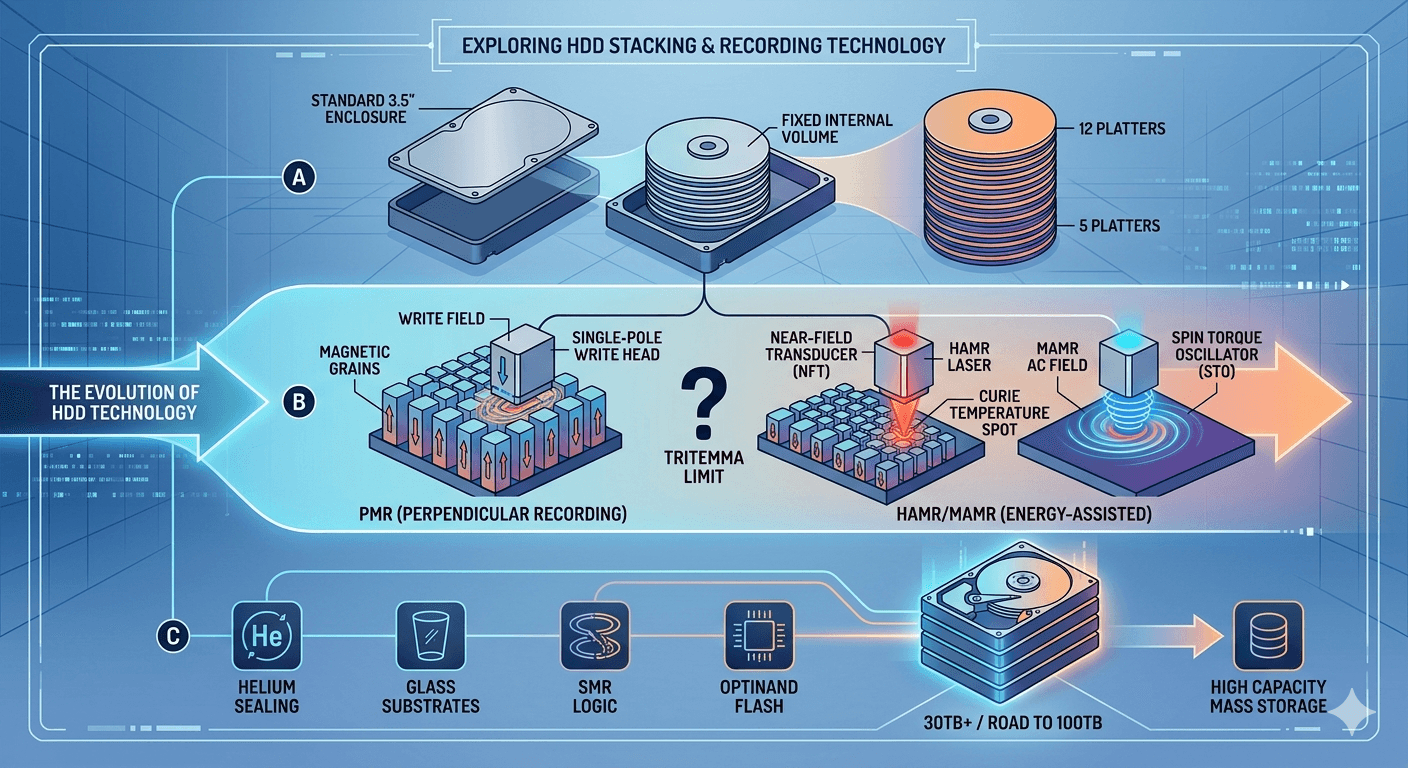
- To increase areal density, grain size must shrink.
- Smaller grains have worse thermal stability, shortening data retention.
- To maintain thermal stability, materials with higher coercivity must be used, but the write field generated by the head is limited by material saturation magnetization and miniaturization, preventing infinite enhancement.
The logic of Energy-Assisted Recording is to inject additional energy into the magnetic medium at the moment of writing, temporarily lowering its coercivity, and restoring it to a high-coercivity state after the write is complete. Two mainstream technical routes are currently developing in parallel.
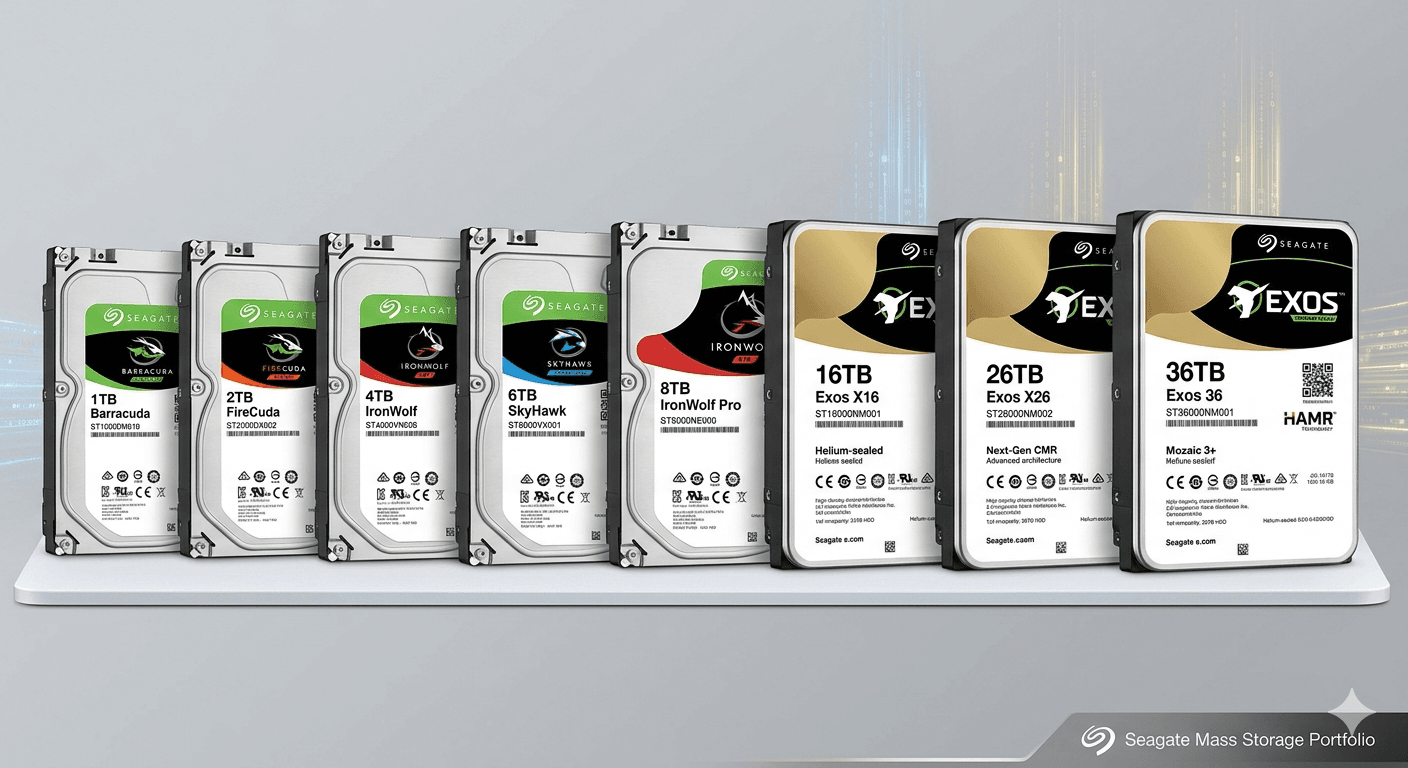
Heat-Assisted Magnetic Recording (HAMR). Led by Seagate, HAMR technology integrates a miniature laser diode and a Near-Field Transducer (NFT) on the head, instantaneously heating the write area to near the Curie temperature of the medium (approx. 577°C for Iron-Platinum alloys). The material’s magnetic properties weaken temporarily, allowing a conventional write field to flip its magnetization. After cooling, the medium recovers extremely high coercivity, making data stability superior to traditional PMR. The theoretical limit for HAMR areal density can reach 5Tb to 10Tb per square inch. Seagate has reached a single-disk density of 6.9TB in the lab and plans for a 15TB single-disk target. In terms of mass production, 30TB and 36TB HAMR drives have already begun shipping to data center customers.
Microwave-Assisted Magnetic Recording (MAMR). MAMR technology integrates a Spin Torque Oscillator (STO) near the write head to assist magnetic moment flipping via a microwave-frequency alternating magnetic field. Unlike HAMR, MAMR does not require high-temperature heating; its operating temperature is comparable to PMR drives, placing lower thermal stability demands on head lubricants and disk media. It is considered more competitive in terms of long-term reliability and manufacturing costs. Both Toshiba and Western Digital are pushing MAMR as a primary technical route, with Toshiba’s MAS-MAMR already entering commercial deployment.
Chapter 4: Differentiated Technical Strategies of the Three Major Vendors
The global HDD market presents a tripartite structure of Seagate, Western Digital, and Toshiba. The three have different focuses in pushing stacking technology, forming differentiated competitive routes.
| Vendor | Core Technical Strategy | Representative Technology/Architecture |
|---|---|---|
| Seagate | HAMR First & Dual Actuator Architecture | Mass-produced Exos 30 and Exos M 36TB HAMR in 2025; MACH.2 technology provides dual independent arms for doubled IOPS. |
| Western Digital | ePMR/OptiNAND & HAMR/MAMR Parallel | OptiNAND integrates flash on the controller to offload metadata; Ultrastar DC HC680 26TB uses 10-disk ePMR. |
| Toshiba | Disk Count Race & MAMR Adherence | Jump from 10 to 12 disks using glass substrates; MAS-MAMR planned for 40TB delivery in 2027. |
The coexistence of these three routes is healthy for the industry—parallel verification of different technical hypotheses reduces the systemic risk of a single route failure and provides diverse procurement options for downstream customers.
Chapter 5: Engineering Challenges and Countermeasures in High-Density Stacking
5.1 Thermal Management
The increase in platter count and head write power (especially HAMR laser heating) leads to higher heat dissipation per drive. In multi-bay servers or storage arrays, drives are closely packed; under air-cooling, inlet temperatures rise along the chassis depth, easily forming local hotspots.
Precision Immersion Cooling is becoming an alternative for ultra-scale data centers. A joint study by Iceotope and Meta showed that in a dielectric liquid immersion environment, the temperature difference of 72 hard drives can be controlled within 3°C, with cooling power consumption less than 5% of the total system power—significantly lower than traditional fan-wall solutions. The liquid medium also suppresses the propagation of rotational vibration, offering additional benefits for reducing multi-drive coupling vibration.
5.2 Vibration Suppression
Multi-disk stacking increases the rotational inertia on the spindle, and the modal vibrations of the platters themselves become more complex. In multi-bay chassis, the seek actions of different drives generate transient shock excitations, causing chassis resonance.
Modern enterprise HDDs are commonly equipped with built-in three-axis accelerometers. Firmware runs Rotational Vibration (RV) compensation algorithms, real-time analyzing the vibration spectrum and driving the VCM to apply reverse compensation displacement, keeping the head stable at the center of the target track. At the mechanical design level, StableTrac technology, which secures the spindle at both ends, reduces axial movement of the platter assembly.
5.3 Reliability Statistics
Cloud backup provider Backblaze continues to publish annual failure rate statistics based on hundreds of thousands of drives, providing a large-sample reliability reference. The 2025 report shows that the overall Annualized Failure Rate (AFR) for HDDs was 1.30%, a further decline from previous years. Long-term trends are more noteworthy—plotting failure rates against service age, the 2025 peak (at approximately 10 years and 3 months) was only 4.25%, whereas the 2013 peak was 13.73%. In twelve years, the peak failure rate has decreased by about two-thirds. This indicates that as Helium sealing, RV algorithms, and head flying control technologies mature, the long-term reliability of high-density stacked drives has not deteriorated; rather, it has significantly improved.
Chapter 6: Differentiation between Physical Stacking and System Stacking
In the context of the storage industry, the term “stacking” exists at two levels that must be distinguished:
Internal Drive Stacking is the core of this discussion—increasing capacity within a single 3.5-inch drive by adding platters and enhancing areal density. This falls under the design and process domain of hard drive manufacturers.
Storage System Stacking refers to JBOD or RAID architectures, where multiple independent drives are connected to a controller via SAS/SATA buses to form a unified logical volume. This is the responsibility of storage system integrators or data center operations engineers.
Both types of “stacking” serve the common goal of capacity expansion, but their implementation levels and technical difficulties are fundamentally different. Confusing the two can lead to misunderstandings in technical discussions.
Chapter 7: Future Outlook — Timeline for 100TB HDDs and Technological Convergence
Based on the public roadmaps of the three major vendors, the capacity evolution nodes for the coming years are relatively clear:
- 2026: 30TB to 36TB products are in the mass-production ramp-up phase. Seagate HAMR 30/36TB has shipped; Western Digital 26TB–30TB ePMR products are in production, and 40TB UltraSMR ePMR is undergoing customer validation.
- 2027: 40TB-class products will hit the market in concentration. Toshiba’s 12-disk MAMR and Western Digital’s HAMR-based mass-production models are expected to launch during this period.
- Post-2027: 50TB and 60TB will gradually land. Western Digital’s HAMR roadmap extends to the 100TB level, expected to be realized around 2029.
The trend of technological convergence is obvious. A single path is unlikely to support the leap to 100TB. Future hard drives will be an integration of Helium sealing, 12+ disk stacking, glass substrates, HAMR or MAMR energy assistance, dual-actuator architectures, flash metadata offloading, and many other technologies. The continuous decline in cost per TB will solidify the role of HDDs in AI data lakes, large-scale cold storage, and content delivery networks (CDNs).